
When people think of Japanese food, sushi, ramen, tempura, and miso soup may come to mind first.
However, there is another food that has long been part of everyday Japanese meals: pickles.
Japanese pickles are called “tsukemono.” They are usually served in small portions alongside rice, soup, and other dishes.
Some are salty, some are sour, and some have a slightly sweet flavor. Their bright colors and crisp textures can also add variety to the table.
Why do Japanese people eat pickles with rice?
The answer is connected to the mild flavor of Japanese rice, traditional food preservation, local ingredients, and the balance of a meal.
What Are Tsukemono?
The Japanese word “tsukemono” comes from the verb “tsukeru,” which means to soak or pickle.
Vegetables and other ingredients are preserved or seasoned in salt, rice bran, vinegar, miso, soy sauce, sake lees, or other pickling beds.
Common vegetables used for tsukemono include:
- Daikon radish
- Cucumber
- Eggplant
- Chinese cabbage
- Turnip
- Ginger
- Carrot
Plums, known as “ume,” are also used to make umeboshi. Although umeboshi is often called a pickled plum in English, ume is botanically closer to an apricot.
Tsukemono can be homemade, purchased from supermarkets, or served at restaurants and traditional inns.
The Strong Flavor Goes Well with Plain Rice
Japanese white rice is usually served without salt, butter, oil, or sauce.
Its flavor is mild, soft, and slightly sweet.
Tsukemono often has a stronger taste. It may be salty, sour, sweet, spicy, or rich in umami.
Because of this contrast, even a small piece of pickle can make plain rice more enjoyable.
A person might take a bite of rice, eat a little pickle, and then return to the rice. The salty or sour flavor of the pickle brings out the natural sweetness of the rice.
Tsukemono is not usually eaten in large amounts like a vegetable salad. A small serving is enough to add flavor and variety to the meal.
Pickles Can Refresh the Mouth
Japanese meals often include several different flavors and cooking methods.
There may be grilled fish, simmered vegetables, miso soup, fried food, tofu, or meat.
A crisp or sour pickle can refresh the mouth between bites of richer or more strongly seasoned dishes.
This is sometimes described as “kuchi-naoshi,” meaning something that refreshes or resets the palate.
For example, a slice of lightly pickled cucumber may feel refreshing after grilled fish. A small piece of takuan can add crunch to a soft meal of rice and simmered vegetables.
The role of tsukemono is not only to add saltiness. It can also change the rhythm of the meal through its acidity, aroma, color, and texture.
Popular Types of Japanese Pickles
There are many different kinds of tsukemono in Japan.
Takuan
Takuan is made from daikon radish.
It is often yellow, crunchy, slightly sweet, and salty. It is commonly served with rice, in bento boxes, and alongside traditional meals.
Umeboshi
Umeboshi is made by preserving ume fruit with salt.
It has a strong sour and salty flavor. Some varieties are also seasoned with shiso leaves, honey, or bonito flakes.
Umeboshi is often placed inside onigiri or served in a small amount with rice.
Nukazuke
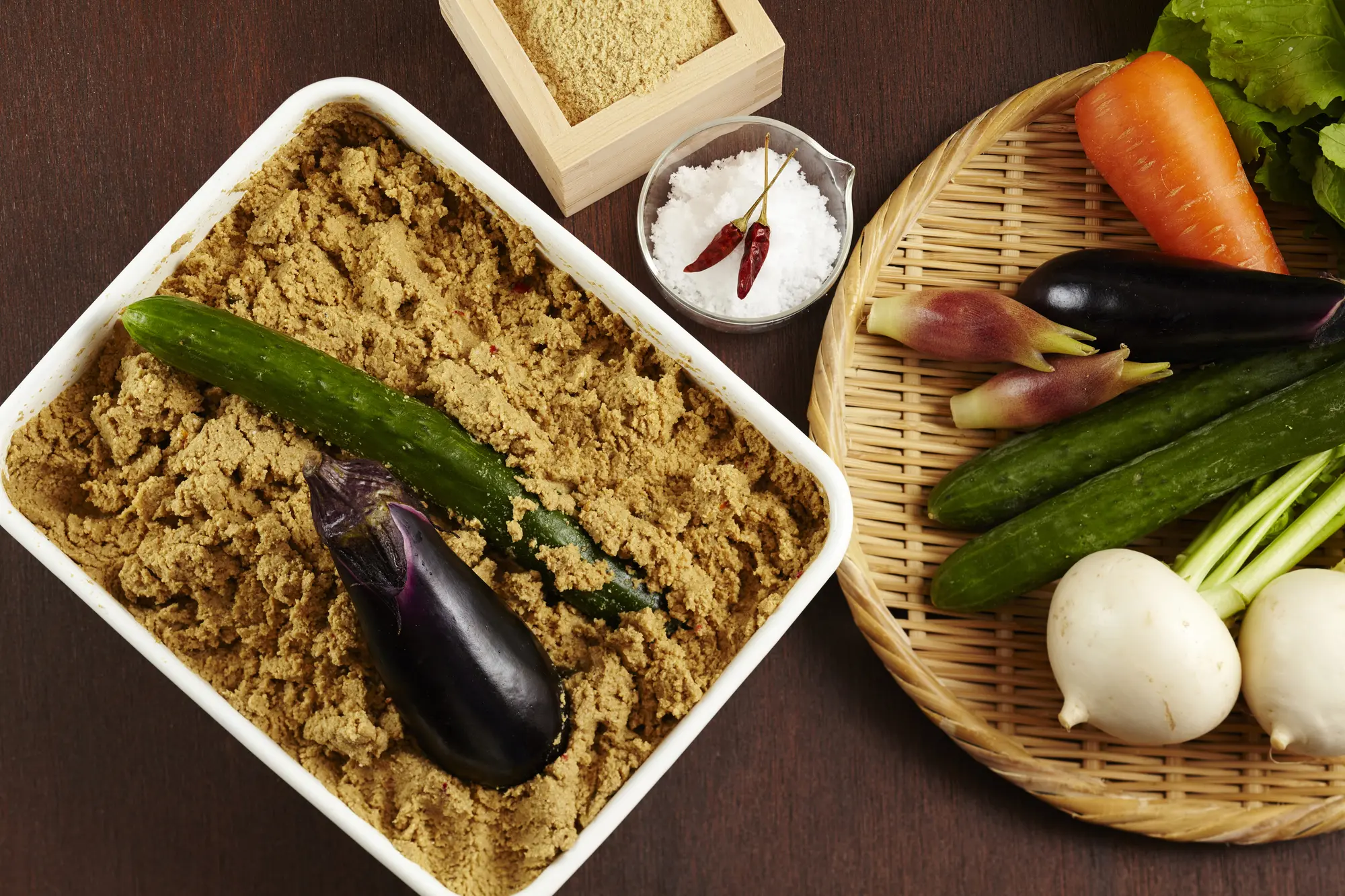
Nukazuke is made by placing vegetables in a fermented rice-bran bed called “nukadoko.”
Cucumbers, eggplants, daikon radishes, and carrots are commonly used.
The vegetables develop a distinctive aroma, gentle acidity, and deep flavor through fermentation.
Asazuke
Asazuke means “lightly pickled.”
Vegetables are seasoned for a relatively short time with salt, vinegar, kombu seaweed, or other ingredients.
Asazuke is fresh, crisp, and easy to make at home. Because it is only lightly preserved, it is generally eaten soon after preparation.
Shibazuke
Shibazuke is associated with Kyoto.
It is traditionally made with vegetables such as eggplant and cucumber, often colored and flavored with red shiso leaves.
It has a pleasantly sour and salty taste and is known for its vivid reddish-purple color.
Are All Japanese Pickles Fermented?
Not all tsukemono are fermented.
Some pickles develop their flavor through the activity of microorganisms over time. Nukazuke is a well-known example of fermented tsukemono.
Other pickles are made more quickly with salt, vinegar, soy sauce, or seasonings and may not undergo significant fermentation.
Asazuke, for example, is often eaten before fermentation develops.
This means that the words “Japanese pickles” and “fermented foods” are not exactly the same.
Some tsukemono are fermented, while others are primarily salted, seasoned, or preserved.
The method, ingredients, temperature, salt level, and pickling time all affect the final flavor and texture.
Pickles Developed as a Way to Preserve Food
Before refrigerators became common, pickling was an important way to preserve vegetables.
Vegetables harvested in one season could be salted, dried, fermented, or stored in a pickling bed for later use.
This was especially useful during winter or in places where fresh vegetables were not available throughout the year.
Pickling also helped people avoid wasting seasonal produce.
When a large amount of daikon, cucumber, Chinese cabbage, or another vegetable was harvested at once, some could be eaten fresh and the rest preserved.
Over time, these practical preservation methods became part of local food culture.
Tsukemono Vary Across Japan
Japan stretches a long distance from north to south and has different climates, landscapes, and agricultural products.
As a result, the types of pickles vary from region to region.
In colder areas, stronger salting and longer preservation were traditionally important for keeping food through winter.
In warmer regions, different vegetables, spices, citrus fruits, or preservation methods developed according to the local climate.
Regional crops also influence what people pickle.
One area may be known for daikon radish, while another may use local turnips, mustard greens, eggplants, ginger, or mountain vegetables.
Seasonings also differ. Some pickles use rice bran, while others use miso, soy sauce, vinegar, koji, sake lees, or kombu.
Tsukemono are therefore more than one type of food. They reflect the climate, farming, history, and tastes of each area.
Trying local pickles while traveling can be one way to discover the food culture of different parts of Japan.
Are Japanese Pickles Always Healthy?
Tsukemono are often associated with traditional Japanese food and fermentation, but it is better not to assume that every pickle is automatically healthy.
Many traditional pickles contain a considerable amount of salt. Some commercially produced varieties may also include sugar, coloring, sweeteners, or other seasonings.
Fermented pickles can contain microorganisms created during the fermentation process, but not every packaged pickle contains live bacteria by the time it is eaten.
The nutritional qualities vary depending on the ingredients and production method.
In a Japanese meal, pickles are usually eaten in small amounts. Their main roles are to add flavor, texture, color, and contrast rather than to serve as a large vegetable dish.
Do Japanese People Eat Pickles at Every Meal?
Japanese people do not necessarily eat tsukemono at every meal.
A traditional breakfast or dinner may include a small plate of pickles, but many modern meals do not.
Eating habits differ between households.
Some families regularly make nukazuke or asazuke at home. Others buy pickles occasionally, eat them only at restaurants, or rarely serve them at all.
Younger generations may also eat pickles less frequently than people who grew up with them as an everyday part of the table.
Tsukemono remain an important part of Japanese food culture, but they should not be seen as a rule that every Japanese person follows at every meal.
A Small Dish with a Long History
Japanese pickles may look like a very small part of the meal, but they carry a long history.
They developed as a practical way to preserve seasonal vegetables. They also add saltiness, sourness, aroma, color, and texture to plain rice and other dishes.
Some are fermented, while others are quickly seasoned. Some are found throughout Japan, while others reflect a particular region and its local ingredients.
This diversity is one of the most interesting things about tsukemono.
They show how Japanese home cooking has developed through the seasons, local agriculture, and the need to use food carefully.
At Kitchen Bee in Tokyo, guests can experience Japanese home cooking through familiar dishes such as rice, miso soup, tamagoyaki, and onigiri.
By learning how these everyday foods are prepared and eaten together, you can discover the balance of flavors and small details that make up a Japanese home-style meal.